Organic Fertilizer
What Is Organic Fertilizer?
Organic fertilizer is a plant nutrient source made from natural materials such as compost, vermicompost, animal manure, plant residues, neem cake, oil cakes and other suitable organic materials.
These products can provide nutrients while also contributing organic matter to the soil. Many organic materials depend on microbial decomposition before nutrients become readily available to plants.
This makes them different from highly soluble fertilizers that can provide nutrients in readily available forms.
For farmers, gardeners and home growers, selecting an appropriate product depends on the crop, soil condition, nutrient requirement, application method and quality of the material.
It supplies nutrients from natural sources and, depending on the material, can add organic matter and support the physical and biological condition of the soil.
Why Is Organic Fertilizer Important?
Healthy soil provides the foundation for healthy plant growth.
Organic materials can contribute to soil organic matter and support important soil processes. Appropriate organic inputs can help improve soil structure, water-holding characteristics and microbial activity.
However, the effect depends on the type and quality of the material, application rate, soil characteristics and overall crop-management system.
For this reason, organic fertilization should be considered part of a complete soil-fertility program rather than a single solution for every farming problem.
What Are the Main Types of Organic Fertilizer?
Different organic materials provide different nutrients and soil benefits. Understanding the differences can help farmers and gardeners select the appropriate product.
1. Vermicompost
Vermicompost is produced through the biological processing of suitable organic materials by earthworms and microorganisms.
It is widely used in vegetable gardens, nurseries, horticulture, fruit production and field agriculture.
Vermicompost can contribute organic matter and nutrients while supporting biological activity in the growing environment.
Common uses: vegetables, flowers, nursery plants, fruit plants, containers and agricultural soils.
2. Compost
Compost is produced through the controlled decomposition of suitable organic materials.
Mature compost can be incorporated into soil or growing media to add organic matter and supply nutrients.
Quality is important. Compost should be adequately decomposed and suitable for its intended application.
Common uses: vegetable gardens, landscaping, horticulture, nurseries and farms.
3. Neem Cake Fertilizer
Neem cake is obtained from neem seed material after oil extraction.
It is widely used as an organic nutrient input in Indian agriculture and horticulture.
Farmers commonly use neem cake around vegetable crops, fruit plants, plantation crops and ornamental plants according to product recommendations.
4. Castor Oil Cake
Castor oil cake is produced after oil is extracted from castor seeds.
It can provide organic nutrients and is used in agricultural and horticultural applications.
Nutrient composition can vary between products, so farmers should follow the manufacturer’s specifications and recommended application rate.
5. Farmyard Manure
Farmyard manure generally consists of decomposed animal manure and bedding materials.
It is a traditional organic input used to add organic matter and nutrients to agricultural soil.
Its nutrient composition varies according to the animal source, storage conditions, processing and decomposition.
6. Green Manure
Green manure involves growing suitable plants and incorporating the plant material into the soil.
Certain legumes can contribute nitrogen through biological nitrogen fixation while also adding organic material.
Green manure is commonly used as part of crop rotations and soil-management programs.
7. Biofertilizers
Biofertilizers contain beneficial microorganisms that can support processes such as nitrogen fixation or nutrient solubilization.
They are different from compost and manure because their primary function is biological rather than simply supplying organic matter.
They can be used as complementary inputs where appropriate.
What Are the Benefits of Organic Fertilizer?
The benefits depend on the specific material, soil, crop and application method.
Improves Soil Organic Matter
Organic inputs add carbon-containing material to soil and can contribute to maintaining soil organic matter.
Supports Soil Microorganisms
Organic materials provide substrates that can support microorganisms involved in decomposition and nutrient cycling.
Supports Soil Structure
Organic matter can contribute to better soil aggregation and create a more favorable environment for plant roots.
Helps With Water Management
Soils containing adequate organic matter can have improved water-holding and infiltration characteristics.
Provides Plant Nutrients
Different organic materials provide different amounts of nutrients such as nitrogen, phosphorus, potassium and micronutrients.
Supports Long-Term Soil Management
When combined with appropriate farming practices, organic inputs can contribute to maintaining soil fertility and productivity.
How Does Fertilizer Work?
Many organic materials contain nutrients in organic forms.
After application, microorganisms break down the material. Through decomposition and mineralization, nutrients can gradually become available to plants.
The process can be simplified as:
Organic material → microbial decomposition → nutrient release → plant uptake
The speed of this process varies according to:
- Soil temperature
- Moisture
- Microbial activity
- Material composition
- Carbon-to-nitrogen ratio
- Particle size
- Degree of processing
This is why different organic inputs can behave differently after application.
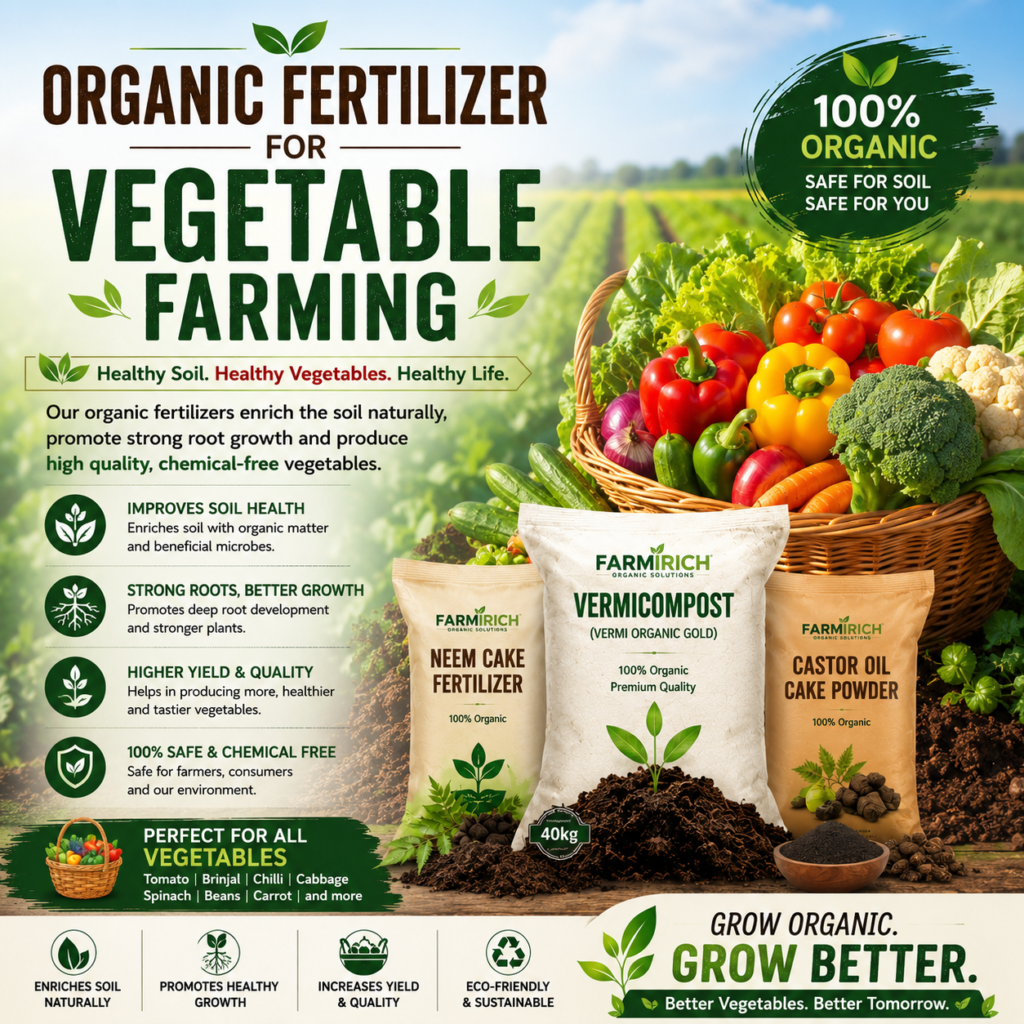
Organic Fertilizer for Vegetable Farming
Vegetable crops require appropriate nutrition throughout their growth cycle.
Common organic inputs used in vegetable production include:
- Vermicompost
- Mature compost
- Neem cake
- Suitable oil cakes
- Farmyard manure
- Appropriate biological inputs
The right application rate depends on the crop, soil and product.
Practical Steps for Vegetable Growers
Step 1: Test the soil where possible.
Step 2: Identify the crop’s nutrient requirements.
Step 3: Select a suitable product.
Step 4: Use mature and properly processed material.
Step 5: Apply according to the product recommendation.
Step 6: Maintain appropriate irrigation and drainage.
Step 7: Monitor plant growth.
Step 8: Adjust the nutrient program when necessary.
Organic does not mean that applying more fertilizer will produce better results. Excessive application can create nutrient imbalances and other problems.
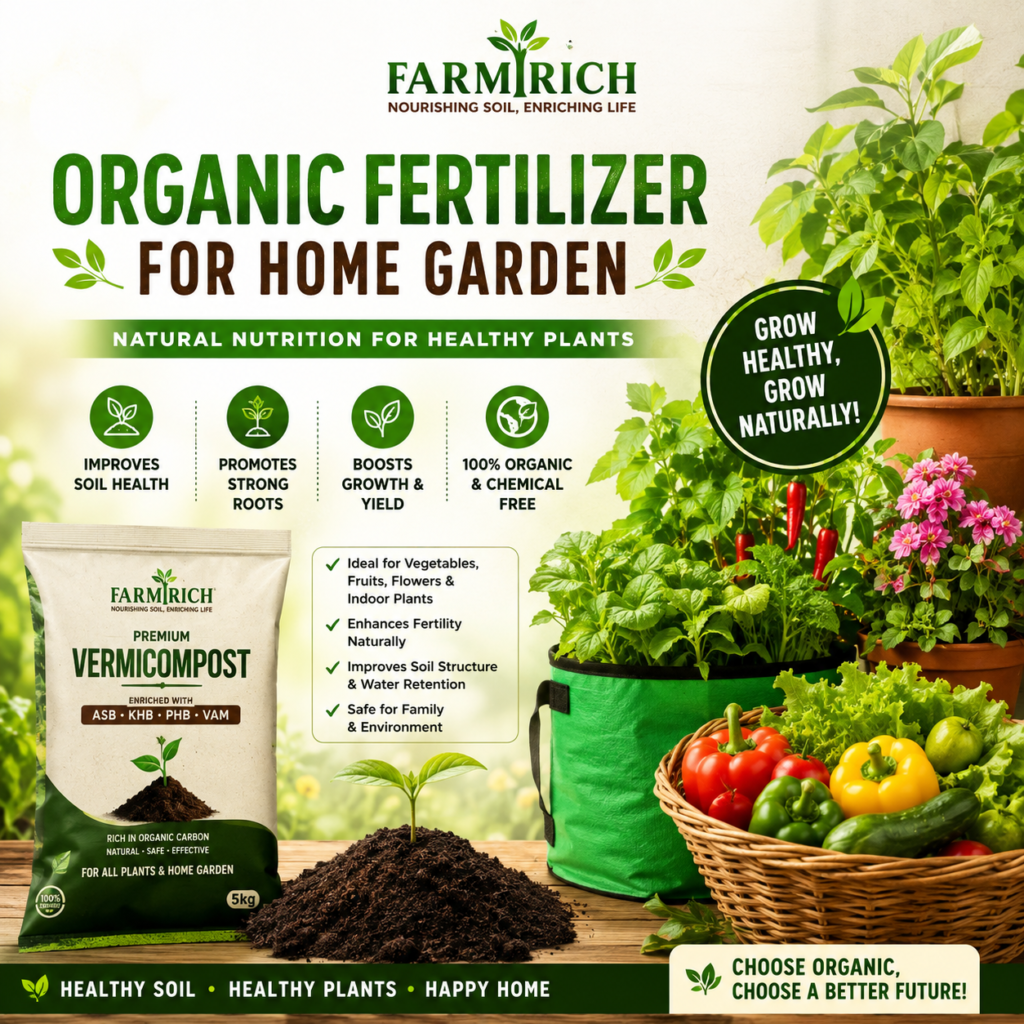
Organic Fertilizer for Home Gardens
Organic inputs are widely used by gardeners growing vegetables, flowers, herbs and ornamental plants.
Vermicompost and mature compost are commonly used in garden soil and container growing media.
Container plants require special care because the root zone is limited.
Before applying any product, consider:
- Plant species
- Pot size
- Growing medium
- Drainage
- Plant age
- Existing nutrient content
- Product recommendations
Applying too much material can be harmful even when the product is organic.
How to Choose the Best Organic Fertilizer
There is no single product that can be called the best for every crop.
The appropriate choice depends on what you want the product to accomplish.
For General Soil Improvement
Mature compost and quality vermicompost can be useful sources of organic matter.
For Additional Organic Nutrients
Neem cake and suitable oil cakes can be incorporated into crop nutrient programs.
For Vegetable Gardens
Vermicompost, compost and crop-appropriate organic nutrient sources can be useful.
For Commercial Farming
Commercial farmers should consider soil-test results, crop nutrient requirements, product nutrient analysis and recommended application rates.
A useful selection formula is:
Soil condition + crop requirement + product quality + nutrient content + application rate
Organic Fertilizer vs Synthetic Fertilizer
Organic and synthetic fertilizers have different characteristics.
| Factor | Organic Fertilizer | Synthetic Fertilizer |
|---|---|---|
| Source | Natural or biological materials | Manufactured nutrient compounds |
| Nutrient concentration | Often lower and variable | Usually more concentrated |
| Nutrient release | Often influenced by decomposition | Often rapidly available |
| Organic matter | Often contributes organic matter | Generally contributes little organic matter |
| Nutrient precision | Can vary | Usually more predictable |
| Application quantity | Often higher | Usually lower |
| Main role | Nutrients plus soil contribution | Targeted nutrient supply |
The choice should be based on the crop, soil and production objectives rather than assuming that one category is always superior.
Are Fertilizers Always Slow-Release?
No.
Many organic materials release nutrients gradually because microorganisms need to decompose them before nutrients become available.
However, the release rate varies considerably.
Important factors include:
- Material composition
- Processing
- Soil moisture
- Temperature
- Microbial activity
- Particle size
- Carbon-to-nitrogen ratio
Therefore, the nutrient-release behavior should be considered for the specific product rather than assumed from the word “organic.”
Can Organic Fertilizer Improve Crop Yield?
Organic inputs can contribute to crop productivity when they improve nutrient availability or soil conditions.
However, crop yield depends on many factors, including:
- Soil fertility
- Water availability
- Seed quality
- Crop variety
- Irrigation
- Pest management
- Disease management
- Weather
- Plant nutrition
- Farming practices
Therefore, it would be misleading to promise a specific yield increase from an organic product without considering these factors.
A better approach is to combine soil testing, appropriate nutrient management and good agricultural practices.
How Much Fertilizer Should You Apply?
There is no universal application rate.
The appropriate amount depends on:
- Crop
- Soil type
- Soil fertility
- Product nutrient content
- Product moisture
- Application method
- Crop growth stage
- Existing nutrient program
For commercial farming, soil testing and crop-specific recommendations are preferable to a generic online dosage.
For packaged products, always follow the manufacturer’s label instructions.
Common Mistakes When Using Fertilizer
Applying Too Much
Excessive application can create nutrient imbalances.
Using Immature Material
Poorly processed organic material may negatively affect plant growth.
Ignoring Soil Testing
Without understanding the soil, it can be difficult to determine what nutrients are actually required.
Assuming Every Product Is the Same
Vermicompost, compost, neem cake and oil cakes have different characteristics.
Expecting Immediate Results
Some organic materials require time for decomposition and nutrient release.
Ignoring Product Quality
Processing, storage, moisture and contamination can affect product performance.
How to Get Better Results From Organic Farming Fertilizer
Good soil management involves more than applying a fertilizer.
Farmers can combine appropriate organic inputs with:
- Soil testing
- Crop rotation
- Mulching
- Efficient irrigation
- Composting
- Crop-residue management
- Integrated pest management
- Quality planting material
- Balanced nutrient management
This approach focuses on long-term soil and crop performance rather than relying on one product.
Frequently Asked Questions
Which Organic Fertilizer Is Best?
There is no universal best product. The right choice depends on the crop, soil and purpose.
Is Vermicompost an Organic Fertilizer?
Yes. Vermicompost is an organic input produced through the biological processing of organic materials by earthworms and microorganisms.
Is it Good for Vegetable Plants?
Appropriately selected and properly processed organic inputs can be useful for vegetable production when applied at suitable rates.
Can it Replace Chemical Fertilizer?
Not necessarily. Crop nutrient requirements vary, and some farming systems may benefit from integrated nutrient management.
How Often Should Fertilizer Be Applied?
There is no universal schedule. Frequency depends on the product, crop, soil and application recommendation.
Can it Improve Soil Health?
Many organic inputs can contribute organic matter and support biological processes and soil structure.
Is More Fertilizer Better?
No. Excessive application can create nutrient imbalances and other problems.
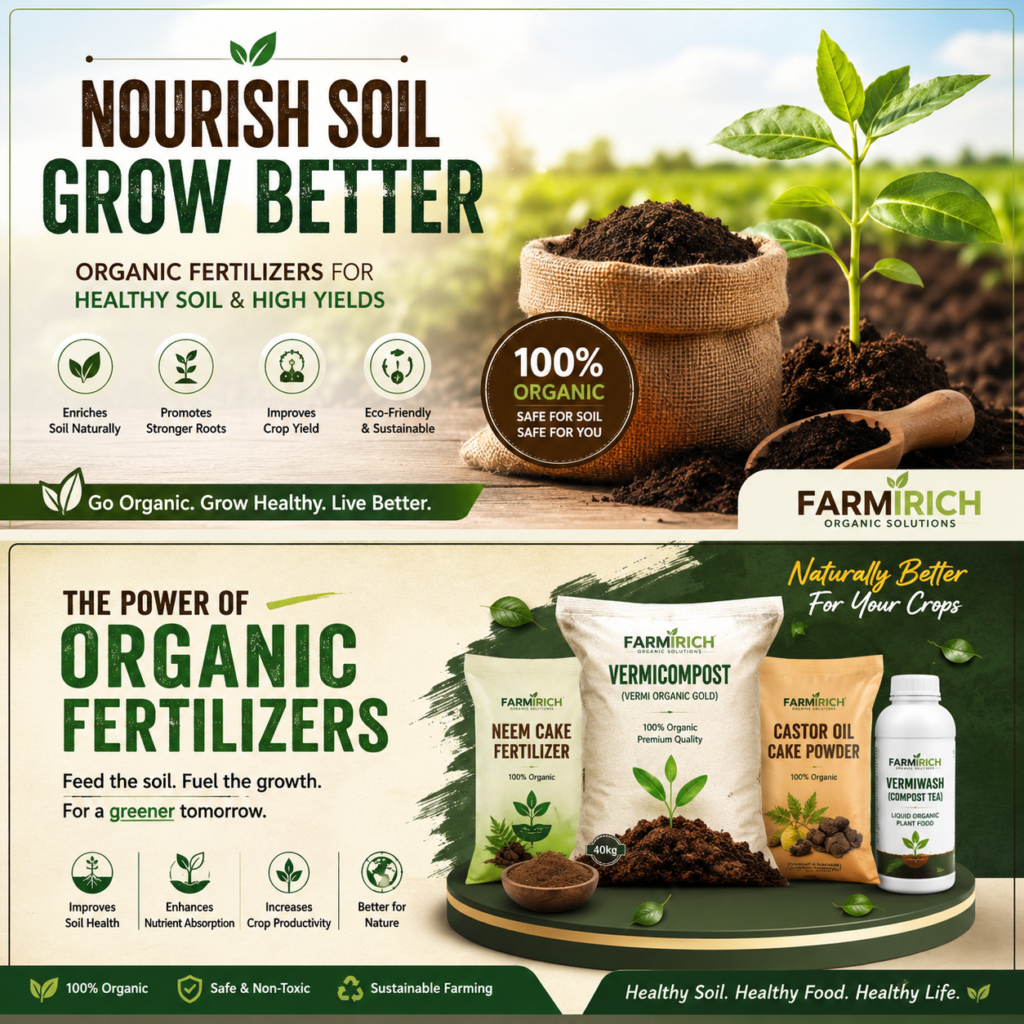
Farmirich Organic Farming Solutions
Farmirich provides organic farming products and solutions for farmers, gardeners, nurseries and agricultural businesses.
The product range includes:
- Vermicompost
- Neem cake fertilizer
- Castor oil cake powder
- Vermiwash
- Organic pest-care solutions
The appropriate product should be selected according to crop requirements, soil conditions and the intended application.
Learn more about Farmirich organic farming solutions at:
Conclusion: Building Healthier Soil With Organic Inputs
Organic fertilizer can be an important part of a practical soil and crop-management program.
Vermicompost, compost, neem cake, oil cakes, farmyard manure and other organic inputs each have different characteristics and applications.
The best approach is not simply to apply more fertilizer. Instead, farmers should understand their soil, identify crop requirements, select suitable products and use appropriate application rates.
When combined with good irrigation, crop management, soil testing and responsible farming practices, organic inputs can contribute to healthier soil and productive crops.
Healthy soil is the foundation of healthy plants, and the right organic inputs can be an important part of sustainable farming.